
Introduction
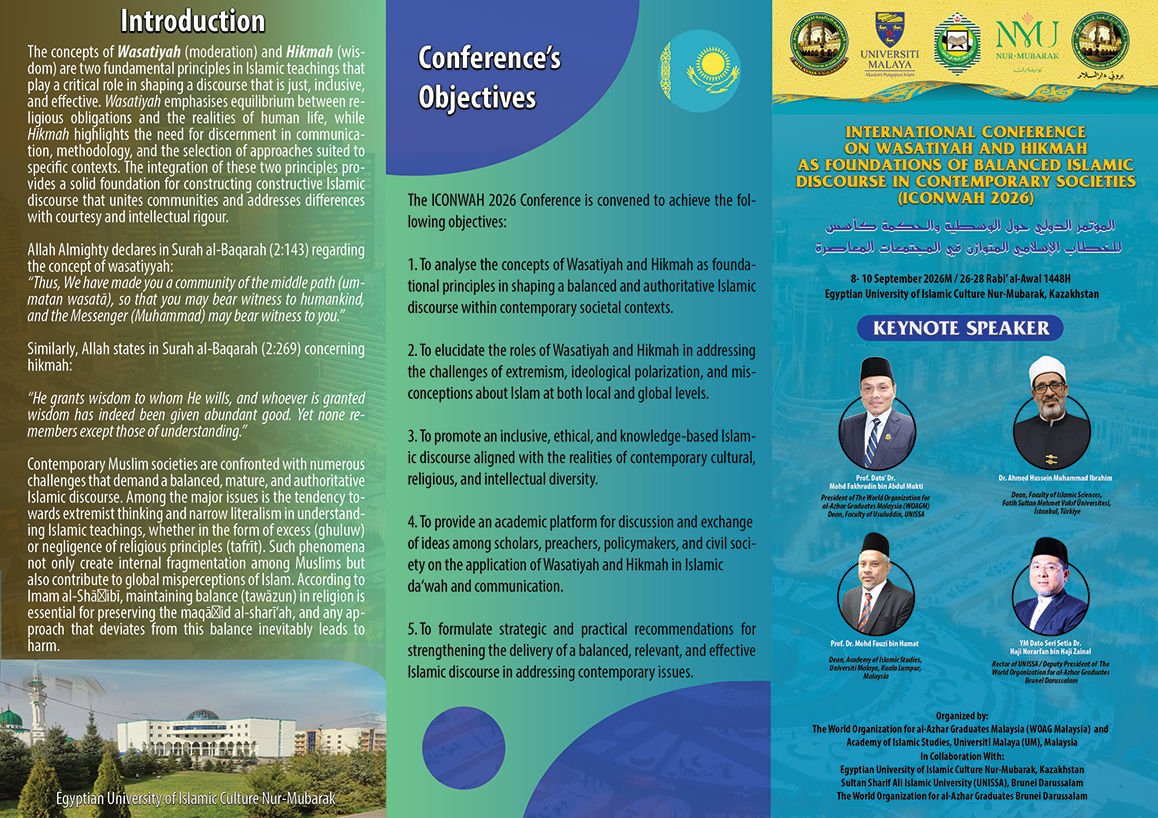
In an era marked by rapid globalization and unprecedented access to information, Islamic discourse faces a range of increasingly complex challenges. These include the rise of extremism, misinterpretations of Islamic teachings, ideological polarization, and the proliferation of unbalanced narratives across digital and social media platforms. Such realities necessitate an approach to Islamic discourse that is not only grounded in the textual sources and scholarly traditions of Islam, but also characterised by maturity, balance, and wisdom in responding to the dynamic and pluralistic nature of contemporary societies.
Conference Objectives
The ICONWAH 2026 Conference is convened to achieve the following objectives:
- To analyse the concepts of Wasatiyah and Hikmah as foundational principles in shaping a balanced and authoritative Islamic discourse within contemporary societal contexts.
- To elucidate the roles of Wasatiyah and Hikmah in addressing the challenges of extremism, ideological polarization, and misconceptions about Islam at both local and global levels.
- To promote an inclusive, ethical, and knowledge-based Islamic discourse aligned with the realities of contemporary cultural, religious, and intellectual diversity.
- To provide an academic platform for discussion and exchange of ideas among scholars, preachers, policymakers, and civil society on the application of Wasatiyah and Hikmah in Islamic da‘wah and communication.
- To formulate strategic and practical recommendations for strengthening the delivery of a balanced, relevant, and effective Islamic discourse in addressing contemporary issues.
Theme
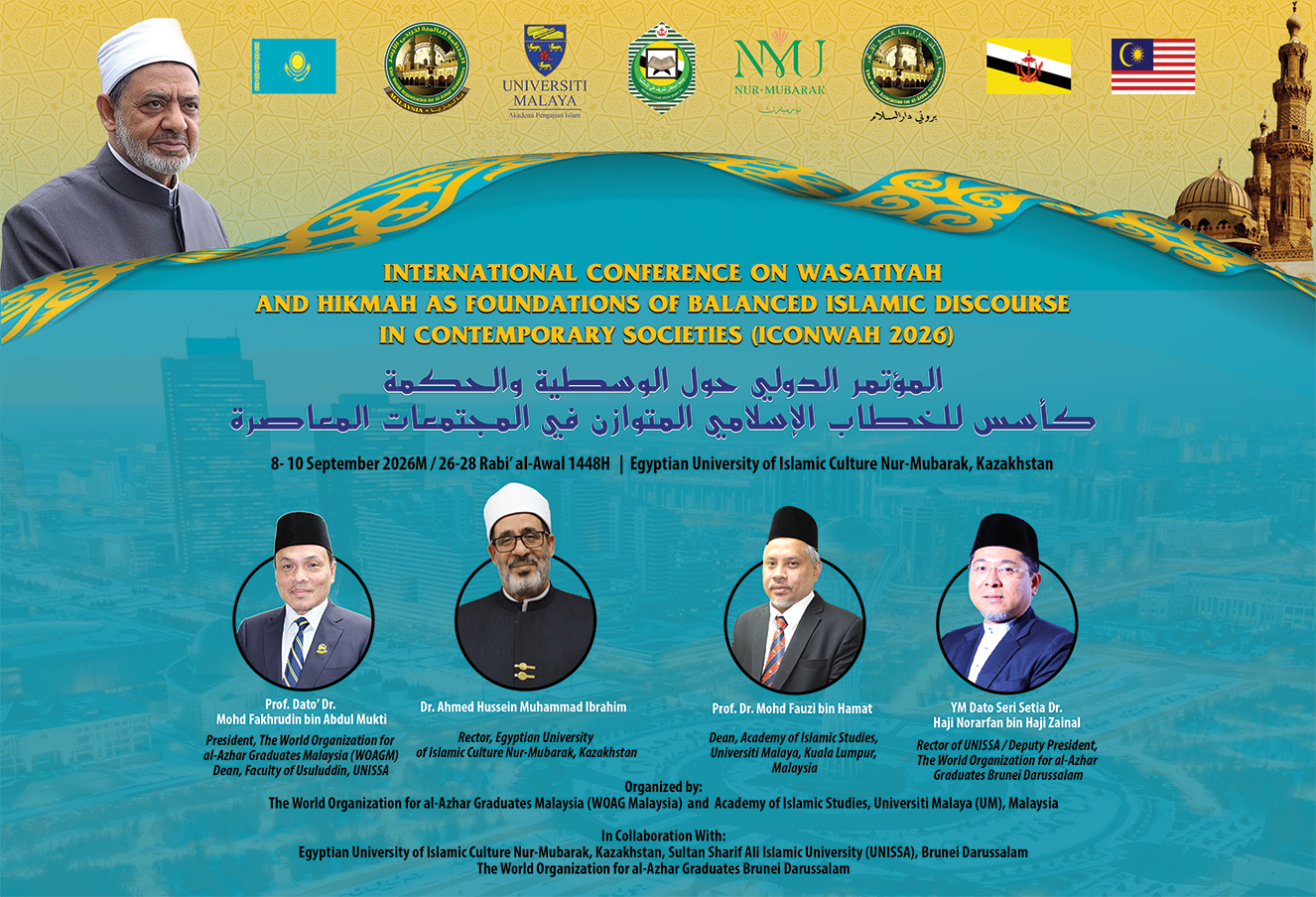
Wasatiyah and Hikmah as Foundations of Balanced Islamic Discourse in Contemporary Societies
الوسطية والحِكمة كأسسٍ للخطاب الإسلامي المتوازن في المجتمعات المعاصرة
This theme will be further explored through a range of sub-themes representing various interdisciplinary fields, including but not limited to:
- The Concept of Wasatiyyah Madaniyyah
- Qur’anic and Hadith Studies
- Islamic Ethics and Principles
- Islamic Education and Human Development
- Islamic Philosophy and Spirituality
- Politics and Leadership
- Sharī‘ah and Islamic Law
- Fatwa and Contemporary Ifta’
- Socio‑Economic Empowerment
- Islamic Turath Studies and Historiography
- Cultural Identity and Diversity
- Islamic Psychospirituality and Counselling
- Complementary and Alternative Medicine in Islam
- Policy and Governance
- Sustainable and Holistic Development
- Arabic Language and Civilizational Studies
- Interfaith Dialogue and Collaborative Engagement
- Digital Society and Artificial Intelligence (AI)
- Environmental Stewardship
Date
8–10 September 2025
Venue
Egyptian University of Islamic Culture Nur-Mubarak, Kazakhstan
Organized By
- The World Organization for Al‑Azhar Graduates (WOAG) Malaysia, Kuala Lumpur
- Academy of Islamic Studies, University of Malaya (APIUM), Kuala Lumpur, Malaysia
In Collaboration With
- Egyptian University of Islamic Culture Nur-Mubarak, Kazakhstan
- Universiti Islam Sultan Sharif Ali (UNISSA), Brunei Darussalam
- World Organization for Al‑Azhar Graduates (WOAG) Brunei Darussalam
Keynote Address / Plenary Speakers
Keynote & Opening Address
Minister of Religious Affairs / Ambassador of Malaysia to Kazakhstan
First Keynote Address
Professor Dato’ Dr. Mohd Fakhrudin bin Abdul Mukti
President, The World Organization for Al‑Azhar Graduates Malaysia (WOAGM)
Dean, Faculty of Usuluddin, UNISSA
Second Keynote Address
Dr. Ahmed Hussein Muhammad Ibrahim
Rector, Egyptian University of Islamic Culture Nur-Mubarak, Kazakhstan
Third Keynote Address
Professor Dr. Mohd Fauzi bin Hamat
Dean, Academy of Islamic Studies, Universiti Malaya
Fourth Keynote Address
Yang Mulia Dato Seri Setia Dr. Haji Norarfan bin Haji Zainal
Rector, UNISSA
Vice President, WOAG Brunei Darussalam
Conference Languages (Papers & Presentations)
The conference will employ three primary languages:
- Arabic
- English
- Malay
Note: All article titles and abstracts must be submitted in bilingual format, with English being compulsory.
Important Dates
- Abstract Submission Deadline: Until 30 May 2026
- Notification of Acceptance: On or before 1 June 2026
- Full Paper Submission Deadline: On or before 15 August 2026
Target Participants and Estimated Number
A total of 200 participants comprising:
- Al‑Azhar Alumni
- Academicians
- Researchers
- Representatives of Institutions and Agencies
- Non‑Governmental Organisations (NGOs)
- Postgraduate Students
- Interested Individuals
Fees

For more information, please contact:
AP Dr. Khadher Ahmad +6019-327 5451
Ustaz Rahim +6013-624 3153
Ustaz Ali +6011-2834 8877